
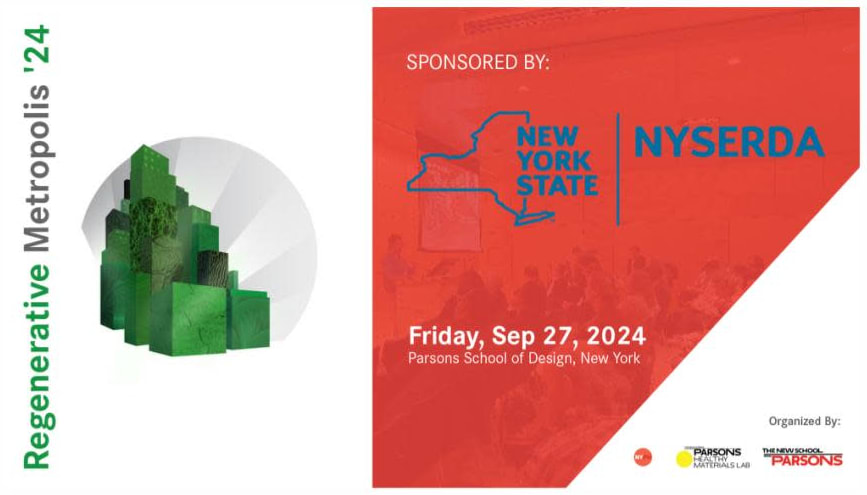
Regenerative Metropolis 2024
Architecture, at its best, embodies our wisest systems knowledge.
Architecture, at its best, embodies our wisest systems knowledge. It provides for human thriving while integrating within all regenerative systems that support the thriving of all life. Positive feedback loops within this type of infrastructure can ensure that abundance is ever increasing, rather than degrading. How can our cities deploy our best understanding of regenerative stewardship? Can urban architecture support best practices within sibling systems such as agriculture, land use, energy, and ecosystem stewardship? We have many tools ready to create the regenerative metropolis: all-electric passive house high performance buildings, carbon sequestering materials such as those created from regenerating soils, holistic local ecological stewardship, and low toxicity products that support health along the entire value chain. How do we scale these solutions so they become the norm? Can we design our cities to enable human activity to support these wise circular systems? Can we align climate policy with social justice goals? Please join us as we seek to unpack these topics and discuss technologies, design, material science, un-siloed science, policy, frameworks, and project examples!
Learnings from the ‘Doughnut for Urban Development A Manual’
“Doughnut for Urban Development: A Manual” is a groundbreaking framework for scaling urban development within social and planetary boundaries. The manual aims to empower professionals with the knowledge and tools for steering the building industry towards a safe and just space for humanity, within the limits of the planet’s natural resources. From setting building targets to taking material choices – How can the Doughnut be applied in practice?
Regenerative Agriculture and the Soil Carbon Solution:
Rodale Institute is a 501(c)(3) nonprofit dedicated to growing the regenerative organic agriculture movement through rigorous research, farmer training, and education. The Institute’s groundbreaking science and direct farmer-support programs serve as a catalyst for change in farming and food production worldwide. Over its 77-year history, Rodale Institute has proven that organic farming is not only viable but essential to mankind’s survival.
Unlocking the Potential of Wood for Climate Good:
Wood products are a key part of a sustainable bioeconomy, but it is important we consider both the upstream forest management and the downstream use in the built environment. This talk will outline the value and principles of climate-smart forestry, and explore the cross-sector collaboration that is needed to scale the production and use of climate-smart wood.
Farming and building in a new way:
The building and agriculture industries together account for around 53% of CO₂ emissions worldwide. By farming and building in a new way, we have the opportunity to sequester more CO₂ than we consume and at the same time grow our homes and cities on a larger scale. In a way we heal our soil and produce real organic food and make buildings that last for generations to come. By co-creating together with nature we can create a better future today.
New York City’s Embodied Carbon Strategy:
New York City is leading by example through its Clean Construction and Embodied Carbon policies. This session will outline those initiatives coming out of the Mayor’s Office of Climate and Environmental Justice and will preview the future of citywide embodied carbon management.
“Earthshot” low emission construction with assemblies optimized for design-for-disassembly:
Henning Larsen Architects and the Nordic developer NREP have combined forces in an “earthshot” multi-story residential project, a project that challenges the Danish low carbon requirements and delivers open-source solutions for best practice low emission construction with assemblies optimized for design-for-disassembly.
Nourishment for People and Planet
In the face of planetary crisis, it’s essential to reconnect with our collective metabolism—food and materials. What if agriculture and construction were the solution?
Event Team:
- Sara Bayer (Event Chair), Board Member, New York Passive House
- Victoria Yee (Event Vice Chair), Board Member, New York Passive House
- Buck Moorhead, Chair, New York Passive House
- Alexander Aptekar, Public Member
- Andreas M. Benzing, Executive Director, New York Passive House
- David J. Lewis, Professor of Architecture, School of Constructed Environments, Parsons School of Design
- Alison Mears, Director, Healthy Materials Lab